Coin Princess x1000
- RTP: 95.72
- Max Win: x20000.00
- Betways: Pay Anywhere
- Volatility: High
- Game Type: Slots
- Release Date: June 26th, 2025

Features we found: free spins, multiplier, cascade
How we rate games
Every slot is scored on the same four criteria, using the game's published data: RTP (40%), maximum win potential (25%), bonus features described in our review (30%) and how recent the release is (5%). Our editors can adjust a score after playing the game. Missing data counts as neutral. The score reflects the game's numbers and features, not your chances of winning; slots are games of chance, so please play responsibly.
|
|
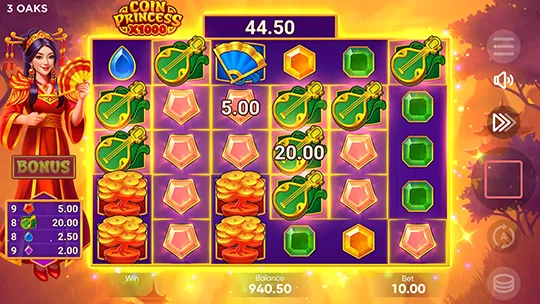
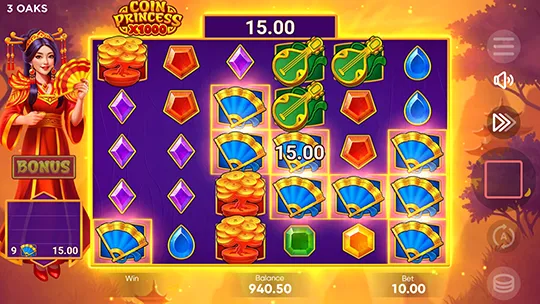
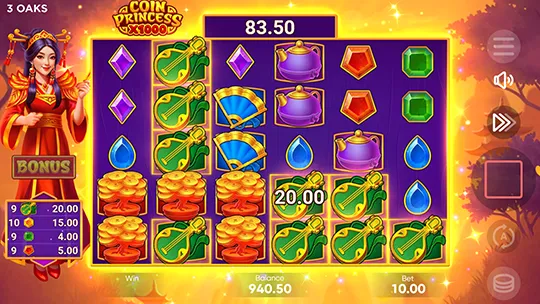
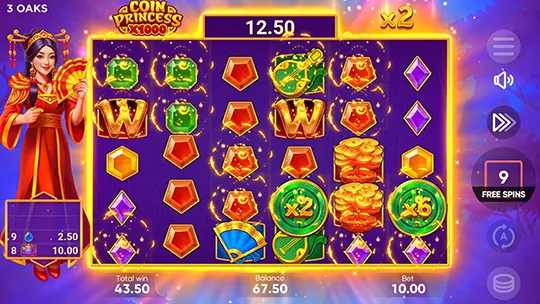
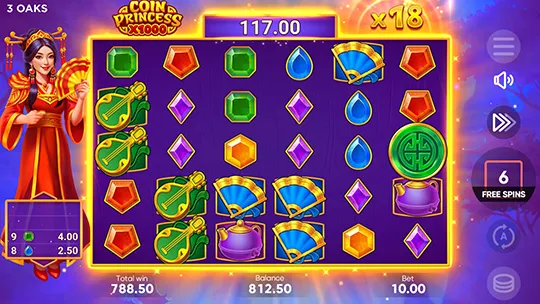
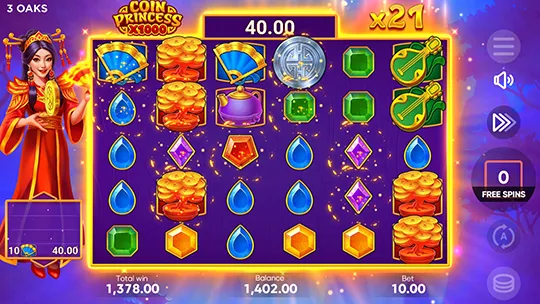
Coin Princess x1000 OverviewCoin Princess x1000 is a 3 Oaks pay-anywhere game on a six-by-five grid, and the number in its title is the top of the free spins multiplier range – printed on the buy menu as MULTIPLIERS: X2 - X1000. The multiplier does not apply to a single spin. It accumulates across the round, and the demo follows one climbing from x2 to x21. Theme and GraphicsThe setting is an imperial Chinese garden in autumn: gold and orange foliage behind the reels, a purple grid panel over the top of it, and red tassels hanging at the corners. A princess in red and gold court dress stands on the left, holding a folding fan. The symbols are Tang-dynasty objects – a stack of gold coins, a green pipa lute, a blue folding fan, a purple teapot – above four cut gems in green, red, orange and purple, plus a blue water drop. A green jade disc carries multipliers, and a W plate serves as the wild. All figures below come from demo play at a 10.00 bet. The art direction is warmer than most Chinese-themed slots manage. Rather than the usual red-and-gold saturation, the background is a real autumn scene with depth to it, and the princess is drawn in full beside the reels rather than pasted onto them – her pose changes between the base game and the feature. Pay Anywhere on Thirty PositionsThere are no paylines. Matching symbols are counted anywhere on the board and paid in three bands: 8–9, 10–11 and 12 or more. The gold coin stack leads at 500.00 for twelve or more, 100.00 for ten or eleven and 50.00 for eight or nine – that is 50x, 10x and 5x. The pipa follows at 200.00 / 50.00 / 20.00, the fan at 150.00 / 40.00 / 15.00 and the teapot at 100.00 / 20.00 / 10.00. Note the shape of the coin stack’s ladder: eight symbols pay 5x, twelve pay 50x. The value multiplies by ten across four extra tiles, and the middle band is only a doubling of the bottom one. As on most pay-anywhere games, the twelve-plus band is where the money is. The Breakdown PanelA panel on the left lists every cluster as it pays, with the count, the symbol and the amount. It makes reading a cascade straightforward. One spin breaks down as 9 fans – 5.00, 9 pipas – 20.00, 8 teapots – 2.50, 8 gems – 2.00, for a total of 44.50 on a 10.00 bet. Another lists 9 gems – 20.00, 10 gems – 15.00, 9 – 4.00, 9 – 5.00, totalling 83.50. Those are 4.5x and 8.4x the stake – from spins carrying four separate clusters each. Two of those clusters were worth a quarter of the bet or less. It is a good illustration of how a busy pay-anywhere board can resolve into a modest number. The demo’s smaller results tell the same story: 12.50 and 15.00 on the 10.00 bet, or 1.25x and 1.5x. The panel also shows why cluster size alone tells you nothing. On one board a nine-symbol cluster is listed at 20.00 directly above a ten-symbol cluster at 15.00 – the larger count paying less, because the two are different symbols sitting on different rows of the paytable. The Accumulating MultiplierInside the free spins a multiplier badge sits at the top right of the screen, and it grows as the round runs. The demo tracks a complete round. With 9 free spins remaining it reads x2 and the total stands at 43.50. With 6 remaining it reads x18 and the total has reached 788.50. At 0 remaining it reads x21 and the round closes at 1,378.00. That is 137.8 times the bet from a single round – on a game whose best possible cluster pays 50x. The growth comes from jade discs landing on the grid carrying their own values. One capture shows two of them at once, reading x2 and x6, on the spin where the global multiplier stood at x2. They add to the running total rather than replacing it, which is how a round climbs from x2 to x21 before the counter runs out. The Buy MenuTwo options are offered, and what separates them is the floor of the multiplier range rather than the ceiling: FREE SPINS – multipliers X2 to X1000 – 1,000.00. At the 10.00 bet those are 100x and 500x the stake. Five times the money, the same maximum, and a starting floor lifted from x2 to x10. Given that the demo’s round opened at x2 and needed most of its spins to climb past x18, beginning at x10 is a meaningful head start rather than a cosmetic one. Whether it is worth five times the price is a different question, and the answer depends on how often the round reaches the upper end of the range at all. A Familiar TemplateAnyone who has played Playson’s Golden Penny x1000 will find this unusually familiar: a six-by-five pay-anywhere grid, cascading wins, a free spins multiplier range quoted as x2–x1000, a premium option raising the floor to x10, a 20,000x ceiling, and buy prices of 100x and 500x the stake. Two different studios, the same skeleton, different art. It is worth knowing when choosing between them, because the thing that actually differs is the paytable underneath – and this one tops out at 50x for its best cluster. None of which is a criticism. Templates circulate quickly in this industry, and a well-built one is better than a badly built original. But a player choosing between two games that look entirely different should know that the machinery is the same. RTP, Volatility and Max WinThe RTP is 95.72%, a little under the modern standard. Volatility is rated High and the maximum win is 20,000x the bet. High is unarguable. A base game where four simultaneous clusters produce four and a half times the stake, against a round that reached 137x in the demo and a ceiling of 20,000x, is about as concentrated a distribution as the format produces. The arithmetic to the ceiling is at least visible: 50x from the best cluster, multiplied by the x1000 at the top of the published range, lands well past 20,000x. The maximum is a good board meeting a very large accumulated multiplier – not a full grid, and not a jackpot. You can try this game on MrJones Online Casino. There’s a unique casino bonus offer of 300% up to £1200 for a limited time. |